|
|
 |
 |
 |
 |
| |
Workcell Simulation Package For Low-Cost Robotics Appraisal
19
May
2008
|
| |
 At a time when sales of industrial robots across continental Europe have risen by 11%, according to the 2007 World Robotics survey, the number of installations in the United Kingdom has fallen by the same proportion. In part, this might be explained by restrained investment in the automotive industry, although this applies equally to other car-producing countries, but the UK has not seen the increased demand from the food & beverage, rubber & plastics, packaging, life sciences and materials handling sectors that is happening elsewhere in Europe. In fact, the UK lags way behind other industrialised European nations, like Germany, Italy, France, Spain and Benelux, in its use of modern robotics technology, putting it on a par with the Eastern European bloc.
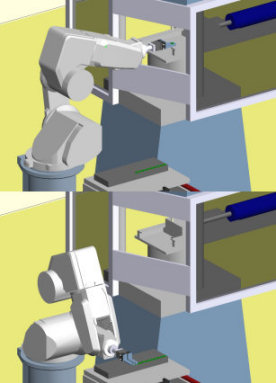
Now, in a bid to reverse the trend and provide UK companies with a low-cost, zero-risk means of determining where robotic solutions might be practicable and affordable, robot integrator and process automation specialist, Barr & Paatz, is offering a fixed price 3D robot workcell simulation package for just £1500, including a digital video of exactly how the application would perform. Owners, production managers, project directors, works engineers and others looking to address the viability of automating specific processes, need only supply a CAD drawing or sketch of the workpiece to be handled, a layout of the proposed process and a brief description of what the robot workcell is expected to do.
“It’s an early procedure we go through on all of our automation projects and it reassures the customer to see how the proposed solution will actually work in the real world, down to the exact make and model of robot, the types of end-effector and transport mechanisms, even the electrical connections,” says Stirling Paatz, MD of Barr & Paatz. “So we thought we’d extend this service to those considering a robotics application, but worrying about the cost of venturing into a full-blown project. We’ll even refund the simulation payment, if the project actually goes ahead.”
“For some reason, our industry is more reticent about robotics than our European counterparts, whether it’s because of our more traditional engineering heritage, our legacy of ageing machinery or union concerns about job losses,” continues Stirling Paatz. “But if we are to retain our competitiveness and prevent work being transferred overseas, we must exploit the speed of throughput, precision and repeatability of processes, and quality of output that robotics technology undoubtedly brings.”
Happily, through specialist robot integrators like Barr & Paatz, which has more than eighteen years’ technology experience, there is no shortage of automation experts in this country, able to design and program robot workcells, taking advantage of the falling real cost of advanced hardware. Barr & Paatz is equipped with the industry-standard COSIMIR 3D simulation and offline programming tool and is able to pre-design robot-based workcells, check the reachability of all positions by the robot arm, simulate operations to avoid collisions, optimise cycle times, then develop programs for robot controllers. Employing its advanced SolidWorks 3D CAD software and practical experience born of commissioning hundreds of installations, the company can then refine the layout, integrate other online processes, link with plant-wide networks and build the workcell, complete with safeguarding.
Working with the basic process information and drawings provided by the customer and its own 3D simulation software, Barr & Paatz will be able to model an accurate workcell, featuring the actual model, type and configuration of robot most suitable for the task, the gripper or end-effector to be used for handling the workpiece, the conveyor belt or other feed mechanisms, and other robots or pick & place devices involved in the process. Included in the £1500 package will be a digital video simulation of the workcell in action, which will prove the viability of the workcell design and be invaluable for internal technical and budget presentations.
“Many standalone factory processes, especially those involving a high level of routine human intervention, can be successfully automated, while cutting-edge robot manufacturers like Mitsubishi now make it an affordable proposition,” says Stirling Paatz. “For a smaller robot workcell, we would expect payback within a year or so, whereas for larger, more complex installations, the return on investment should happen in two or three years. That’s the longer term view on capital investment that our European and Asian competitors are taking, which perhaps explains the greater penetration of robot technology in those regions, and it’s the kind of vision that UK companies should adopt. As they say in the States, automate or stagnate!”
Further enquiries to Barr & Paatz, Ford Road, Totnes Industrial Estate, Totnes TQ9 5LQ, telephone 01803 869 833, email s.paatz@barr-paatz.co.uk. |
|
|
| |
FactoryEquipment.com are not responsible for the content of submitted or externally produced articles and images.
Click
here to email FactoryEquipment.com about any errors or omissions contained within this article. |
| |
|
|
|
|
|
|